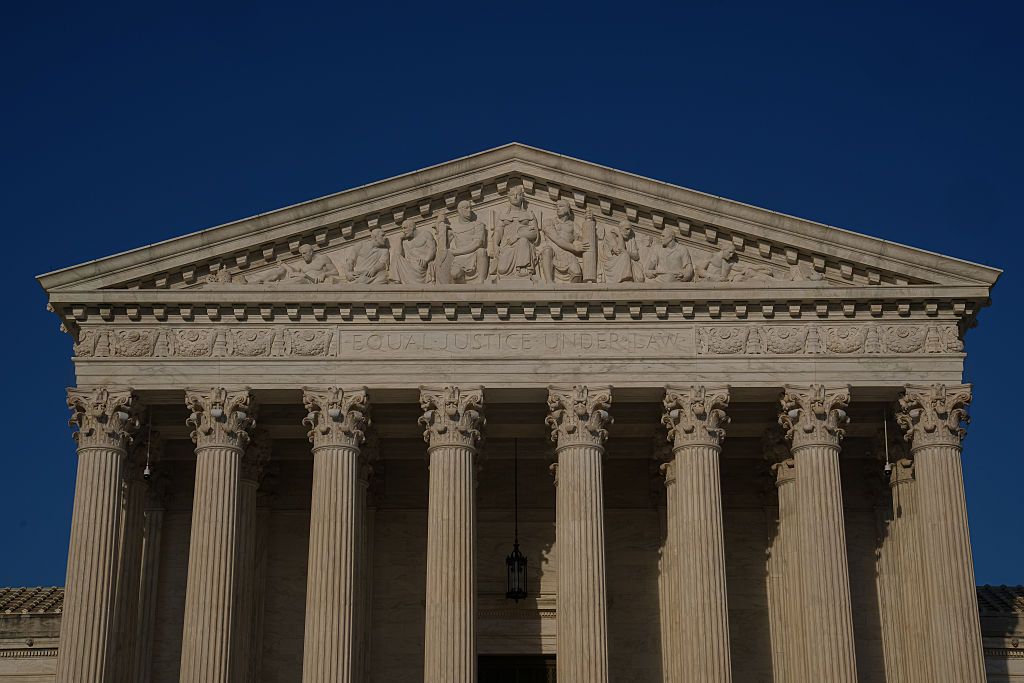
St. Mary Catholic Parish v. Roy, argued before the Supreme Court on November 3, presents a question about whether courts should apply different standards to free exercise of religion claims than to equal protection claims.
Colorado's 2024 universal preschool program provides funding to public, secular private, and faith-based preschools. Schools receiving funds must consent to offer "equal opportunity to enroll and receive preschool services regardless of race, ethnicity, religious affiliation, sexual orientation, gender identity, lack of housing, income level, or disability."
St. Mary Catholic Parish in Littleton, Colorado, which operates a Catholic preschool, and two parents challenged the law. They argued the nondiscrimination requirement violates their free exercise of religion because it requires accepting students whose families do not adhere to Catholic Church teachings, including LGBTQ children and children with LGBTQ parents. The U.S. District Court and the U.S. Court of Appeals for the 10th Circuit upheld the law.
The 10th Circuit applied Employment Division v. Smith, holding that the free exercise clause cannot invalidate a neutral law of general applicability. The court found Colorado's law met this test because it did not discriminate against any religion and treated religious and secular schools equally.
During oral argument, several conservative justices' questions suggested they viewed the law as discriminatory based on its effect on religious schools. Chief Justice John Roberts compared it to Carson v. Makin, noting the effect on religious schools was similar. Justice Amy Coney Barrett asked Colorado's attorney why Colorado cannot impose a condition it knows religious schools "will be unable to agree to."
This approach would differ sharply from equal protection doctrine. For 50 years, since Washington v. Davis, the Supreme Court has held that discriminatory effect alone is insufficient to prove an equal protection violation. The Court has also held that discriminatory purpose cannot be shown merely by proving government officials adopted a policy knowing it would have discriminatory consequences. In Personnel Administrator of Massachusetts v. Feeney, the Court required proof that the government selected a policy "because of," not merely "in spite of," its adverse effects.