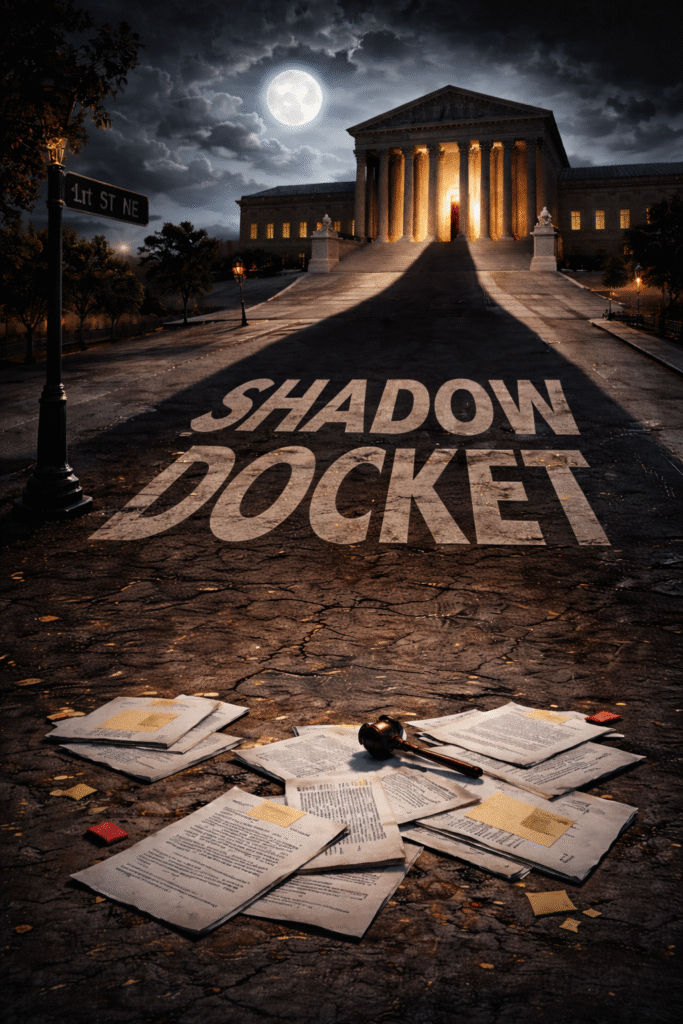
# The Supreme Court's Shadow Docket Becomes Standard Practice, Not Exception
The Supreme Court's use of its shadow docket—emergency orders issued without full briefing or oral argument—has shifted from occasional exception to routine procedure. This transformation carries profound implications for how federal law develops and who gains access to the nation's highest court.
The shadow docket traditionally handled narrow, time-sensitive matters requiring immediate resolution. Applications for emergency stays, injunctions pending appeal, and other expedited requests constituted a small fraction of the Court's work. That framework has collapsed. The Court now resolves consequential constitutional questions through abbreviated, opaque processes that bypass standard deliberative procedures.
This shift accelerated during the Trump administration's first term and has accelerated further in the current period. The Court issues unsigned orders with minimal explanation, often splitting along ideological lines without the transparency of full opinions. Lower court decisions receive reversal or modification through shadow docket action, establishing de facto precedent without the reasoning that shapes legal doctrine.
The practical consequences for practitioners are stark. Lawyers can no longer rely on predictable Supreme Court procedure. Motions for stays and emergency relief now carry the weight of potentially binding law. The abbreviated timeframe for response eliminates thorough legal analysis. Cases that would previously percolate through the circuit courts now leap directly to emergency dockets, where precedent develops without adequate explanation.
Business litigants face new risks. Companies operating under circuit court decisions cannot assume stability. A single emergency application can overturn months of lower court proceedings. The lack of transparent reasoning makes strategic planning difficult. Patent holders, regulatory targets, and civil rights litigants all confront a Court that operates through mechanisms designed for genuine emergencies but deployed for routine substantive decisions.
For free speech and press freedom advocates, the shadow docket has proven particularly consequential. Media outlets challenging government actions must navigate expedited processes where traditional briefing schedules vanish. Gibson Dunn partner Ted Boutrous, who has challenged government restrictions on news outlets, understands the stakes intimately. He helped construct legal frameworks that now face shadow docket review without full adversarial testing.
The institutional costs extend beyond individual cases. Legal scholars cannot extract consistent doctrine from orders lacking reasoned analysis. Circuit courts receive conflicting signals about Supreme Court preferences. The predictability that undergirds the rule of law erodes when the Court's most powerful tool operates in shadow.
Some litigators view this development strategically. Emergency applications now offer pathways to favorable rulings that full briefing might not secure. This creates perverse incentives—parties rush to the shadow docket, abandoning ordinary procedure to escape scrutiny.
Reformers argue the Court must restore procedural transparency. Full opinions on consequential matters serve not as formality but as essential accountability. When the Court rewrites federal law through unsigned orders, lower courts lack guidance and the legal system loses coherence.
The Supreme Court has not formally changed its procedural rules. Instead, practice has shifted beneath official frameworks. Justices increasingly treat the shadow docket as a vehicle for resolving substantive questions rather than managing emergencies. This represents a structural change in how American constitutional law develops.
Courts, litigators, and the public must reckon with a Supreme Court that operates through mechanisms it designed for exception but now treats as routine. That threshold has fundamentally altered how federal law works.