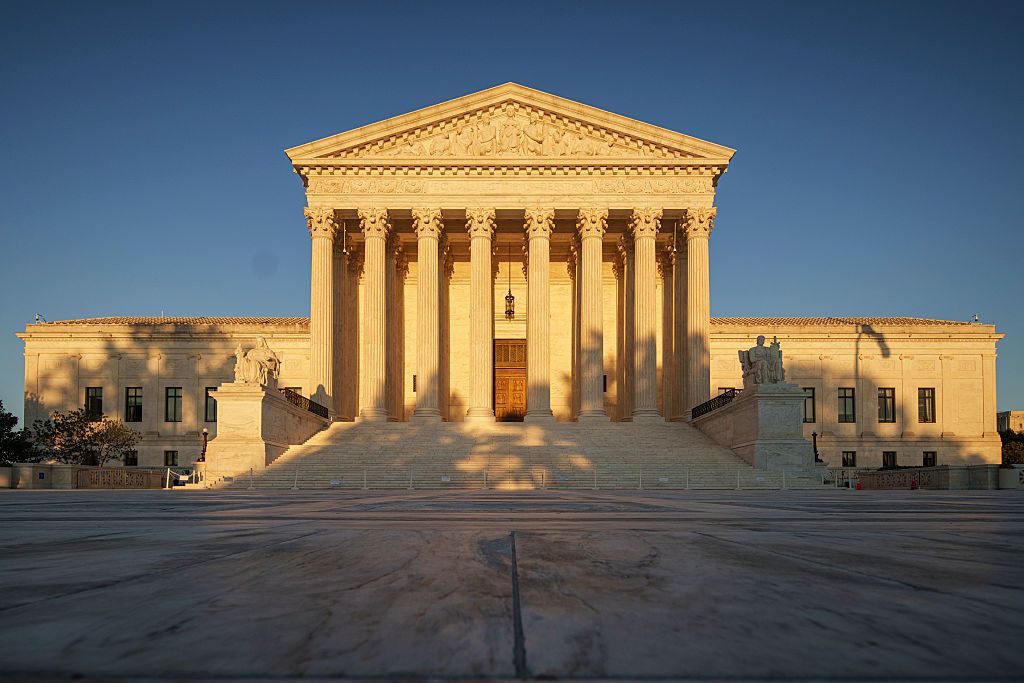
The Supreme Court on Monday suspended a federal judge's order blocking border wall construction in the Big Bend region of southwestern Texas, allowing the Trump administration to resume the project.
U.S. District Judge Kathleen Cardone had halted construction on Oct. 2 after environmental groups, a local landowner, and a church preservation organization challenged waivers issued by the Department of Homeland Security. Homeland Security Secretary Markwaley Mullin and his predecessor Kristi Noem had invoked a provision of the Illegal Immigration Reform and Immigrant Responsibility Act of 1996 authorizing the DHS secretary to "waive all legal requirements" for expeditious border wall construction.
Cardone concluded on Oct. 14 that the challengers were likely to succeed on their claim that the DHS secretary lacked authority to issue the waivers. She applied the major questions doctrine, which requires Congress to speak clearly when delegating power over decisions of vast economic or political significance. Cardone noted that the Big Bend region comprises over 25 percent of the U.S.-Mexico border but accounts for only 0.3 to 2.2 percent of apprehended migrants, contradicting the government's claim that it is an area of high illegal entry.
The Trump administration appealed to the Supreme Court, asking the justices to freeze Cardone's order and summarily reverse it. U.S. Solicitor General D. John Sauer argued that Cardone lacked power to consider the major questions doctrine claim because it was a statutory interpretation question, not a constitutional one, that district courts cannot hear.
The Supreme Court granted the government's request to pause Cardone's order. In its unsigned four-page opinion, the court concluded that the government is "exceedingly likely to prevail" on its argument that Cardone cannot consider a major questions doctrine claim, since that doctrine is a rule of statutory interpretation, not constitutional law. Only Justice Ketanji Brown Jackson indicated she would have denied the government's request.
The court found the government's other interests weighed in its favor, including border security imperatives and costs exceeding nearly half a million dollars per day while construction remains halted. The court concluded the government's interests outweigh "any aesthetic, recreational, and environmental harm alleged by" the challengers.