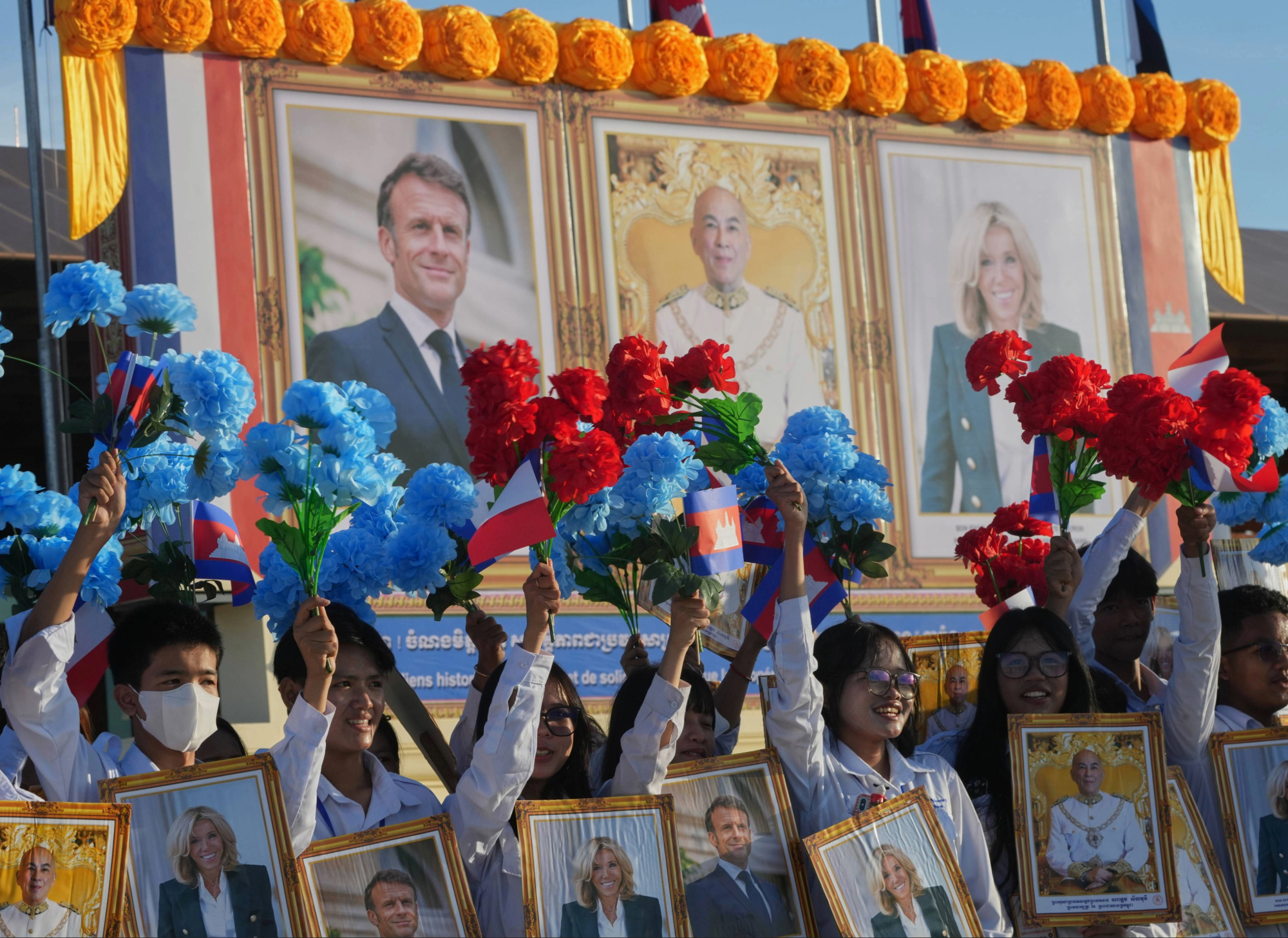
Emmanuel Macron arrives at the Organisation internationale de la Francophonie summit in Cambodia this weekend facing a test that will define the organization's future: whether France will use its substantial influence to prevent the Democratic Republic of Congo from withdrawing and crippling the 90-member coalition. With a population exceeding 110 million people—over 40 million more than France—Congo's departure would mark a significant blow to the organization. Macron must recognize that the stakes here are existential, not merely diplomatic.
The immediate trigger is Monday's election for secretary-general, where Rwanda's Louise Mushikiwabo seeks reelection to a third four-year term while Congo has threatened to leave the OIF if Mushikiwabo prevails. On Saturday, Congo withdrew its alternative candidate, Juliana Lumumba, the 71-year-old daughter of independence hero Patrice Lumumba, and threw support behind Romanian former Prime Minister Dacian Ciolos as a consensus option. This maneuver shows Congo's willingness to compromise—but only if Mushikiwabo is removed from consideration. The underlying conflict is serious: Congo, the United States and U.N. experts accuse Rwanda of backing the M23, one of about 100 armed groups fighting in mineral-rich eastern Congo along the Rwanda border, though Rwanda's government consistently denies these accusations.
Macron's office stated on Saturday that most members agreed on the need for consensus and that he would take up the matter with African counterparts. This is insufficient. As the largest contributor to the OIF 2026 budget of €71.7 million ($79 million), France possesses the financial leverage to shape this outcome decisively. Macron should immediately communicate to Rwanda that reelecting Mushikiwabo will trigger Congo's departure and fundamentally weaken the organization's credibility and reach.
The warning signs are already visible. Mali, Niger and Burkina Faso announced their withdrawals from the OIF in March 2025 following membership suspensions over military coups—but these withdrawals also reflect Francophone African countries shedding what they regard as overbearing French political, military and cultural influence. If Congo follows, the exodus becomes a cascade, and the OIF transforms from a meaningful coalition into a diminished relic.
France cannot afford to lose Congo while managing domestic crises at home. With more than 600,000 people taking to French streets earlier this month demanding higher wages and supporting student protests—resulting in thousands of arrests, hundreds of injuries and schools set on fire—Macron needs a clear diplomatic victory abroad. Supporting the consensus candidacy of Dacian Ciolos provides exactly that. The summit's slogan, 'Reinvest in Peace for Shared Prosperity and Lasting Stability,' rings hollow if France permits its most influential organization to fracture.
Macron should use his influence unambiguously before Monday's vote to ensure Ciolos's election and Congo's continued membership. Anything less abandons the Francophone community to the very fragmentation that threatens its existence.