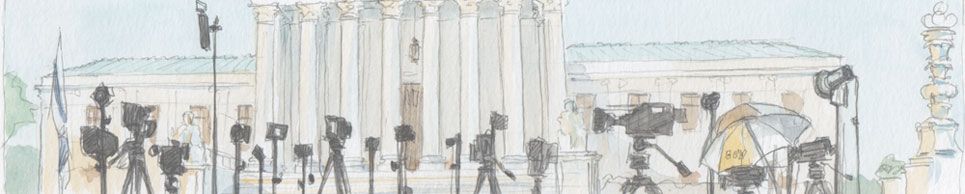
The Supreme Court has added eleven new petitions to its relisting queue for an upcoming conference, signaling possible interest in several high-stakes cases.
The most consequential petition involves Mullin v. Refugee and Immigrant Center for Education and Legal Services. President Donald Trump issued Proclamation 10888 on his first day in office, suspending entry of aliens "engaged in the invasion across the southern border" and barring them from invoking asylum and other statutory protections. Three nonprofits and thirteen individuals sued. A district court certified a class of affected people present in the United States and ruled the proclamation unlawful, issuing a classwide injunction. A divided panel of the U.S. Court of Appeals for the D.C. Circuit affirmed, reasoning that although asylum is discretionary, the executive cannot categorically deny covered migrants access to it by proclamation rather than through procedures Congress prescribed. Judge Justin Walker dissented in relevant part. The solicitor general argues asylum is discretionary and the president may categorically deny it to those covered by the proclamation. Iowa and 21 other states support the petition. Respondents argue Congress expressly gave noncitizens physically present in the United States the right to apply for asylum regardless of entry method, and that the president cannot eliminate that right by proclamation.
Two petitions address whether Washington State may regulate private companies operating federal immigration detention centers. In GEO Group, Inc. v. Nwauzor, a class of detainees and the state sued GEO, which operates the Northwest ICE Processing Center in Tacoma, for not paying Washington's minimum wage to detainees in a voluntary work program. The Washington Supreme Court held the state minimum-wage law applied to detained workers. A 9th Circuit panel rejected GEO's supremacy clause defenses, leaving GEO with a judgment estimated at about $37 million. The solicitor general recommends granting review, arguing the law discriminates against the federal government.
Two related petitions ask when withholding information makes an IPO registration statement misleading under Section 11 of the Securities Act of 1933. In Robinhood Markets, Inc. v. Sodha, investors say the online brokerage withheld information showing that trading and other business metrics were declining at the time of its July 2021 IPO. A district court dismissed their claims, but a divided 9th Circuit panel revived them. Robinhood argues that merely omitting material information cannot create liability unless the omission makes an affirmative statement misleading or violates a specific disclosure requirement.