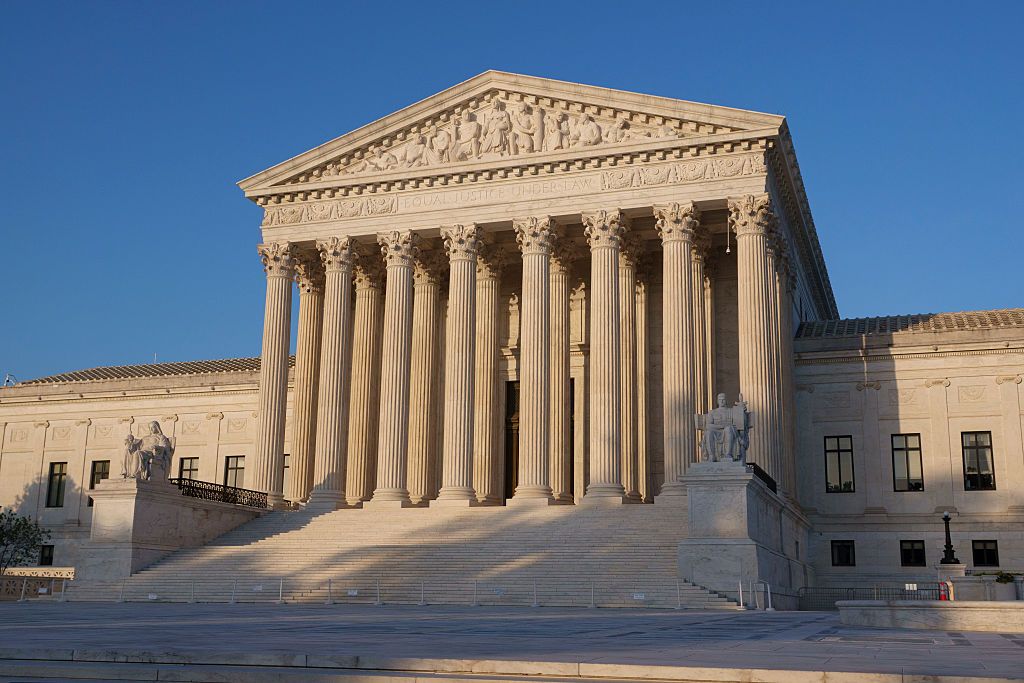
The Supreme Court will hear arguments next week in Hoffmann v. WBI Energy Transmission, Inc., a case about what legal standard applies when courts award compensation to landowners whose property is taken through eminent domain for interstate natural gas pipelines.
The Natural Gas Act grants the Federal Energy Regulatory Commission authority to approve construction of interstate natural-gas pipelines and allows pipeline operators holding a federal certificate to use eminent domain to acquire necessary rights-of-way. The Fifth Amendment requires that property taken for public use receive "just compensation." The dispute centers on whether courts should apply federal standards or state law when determining that compensation.
The Hoffmanns own land in North Dakota through which WBI Energy Transmission seeks to build a pipeline. North Dakota law may require the pipeline operator to pay not only the land value but also the landowner's reasonable attorney's fees. The Hoffmanns argue that state law should apply because eminent domain power here is delegated to a private party, relying on United States v. Kimbell Foods. They contend that absent explicit direction in the Natural Gas Act, state law of the location where the land sits should govern.
WBI and the federal government argue that federal standards must apply because the condemnation power derives from federal law. They point to the General Bridge Act of 1946, enacted around the same time as the Natural Gas Act, which explicitly referenced state law compensation standards. The absence of similar language in the Natural Gas Act, they argue, shows Congress intended federal standards. They also cite United States v. Miller, decided before the Natural Gas Act's adoption, which held that federal compensation standards applied in a prior federal condemnation statute.
The Hoffmanns counter that Miller is irrelevant because it involved a taking by the United States itself, not a private party.
An additional issue likely to arise at oral argument is whether courts may award attorney's fees under the Natural Gas Act when the statute is silent on the topic. The Supreme Court has adopted a clear statement rule requiring explicit congressional authorization before courts award attorney's fees under federal statutes.