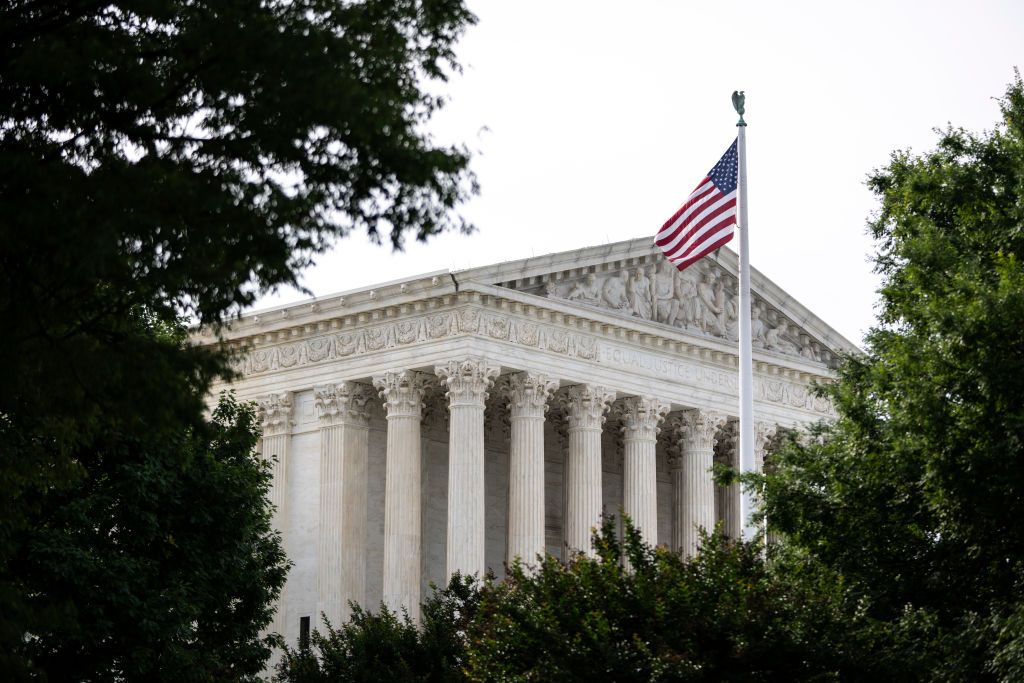
# Supreme Court Rejects Missouri's Congressional Map for Third Time
The Supreme Court declined to intervene in Missouri's congressional redistricting dispute for a third time, leaving in place a lower court map that Democrats argue provides fairer representation. The decision to deny Missouri's application represents another setback for the state's Republican leadership, which sought to implement a map designed to maximize Republican electoral advantage.
Missouri's Republican-controlled legislature passed a congressional map during the 2021 redistricting cycle following the 2020 census. Civil rights groups and Democratic plaintiffs challenged the map in state court, arguing it constituted an unconstitutional partisan gerrymander. A Missouri state court struck down the original map and ordered the legislature to draw a new one.
The legislature's second attempt again faced legal challenges. A three-judge federal panel, applying Supreme Court precedent on partisan gerrymandering claims, found problems with Missouri's approach to representation. The state appealed directly to the Supreme Court, but the justices declined to take the case, leaving the lower court's decision intact.
Missouri made a third attempt with revised boundaries, but courts again found the map failed to meet constitutional standards under state law and potentially federal voting rights principles. When Missouri sought Supreme Court intervention this time around, the justices again refused to hear the case, effectively endorsing the lower court's authority to oversee the redistricting process.
The court's repeated rejections carry several legal implications. First, they signal that the Supreme Court remains unwilling to intervene in state-level redistricting disputes after issuing its 2019 decision in Rucho v. Common Cause, which held that partisan gerrymandering claims present non-justiciable political questions beyond federal court reach. However, Rucho explicitly preserved state courts' authority to address gerrymandering under state constitutional provisions. Missouri's state courts have exercised precisely that power.
Second, the denials underscore a split between state and federal judicial oversight of redistricting. While the U.S. Supreme Court has largely abandoned policing partisan gerrymanders, state courts continue adjudicating claims based on state constitutions and voting rights statutes. Missouri's experience demonstrates this dynamic at work.
The practical consequence for Missouri involves its congressional delegation. The court-ordered map differs from what Republican legislators preferred, altering district compositions and competitive dynamics. The map affects which candidates face viable paths to office and whether certain regions lean solidly Republican or become genuinely competitive.
For Republicans nationally, Missouri's situation reflects broader frustration with state court activism on redistricting. Conservative leaders argue state judges exceed their constitutional authority by second-guessing legislature-drawn maps, while voting rights advocates contend state courts provide the only remaining remedy against partisan abuse after the Supreme Court's Rucho decision.
The state ultimately faces two choices: proceed under the court-ordered map for upcoming elections, or attempt legislative compromise that satisfies both chambers and withstands judicial review. Missouri's Republican supermajority could theoretically pass a new map with Democratic support, but such cooperation appears unlikely given partisan polarization.
The Supreme Court's inaction preserves the lower court map through the 2024 election cycle and beyond, barring successful legislative action. Missouri's repeated failures to satisfy courts suggest the state's political branches and judiciary remain at loggerheads over representation standards.