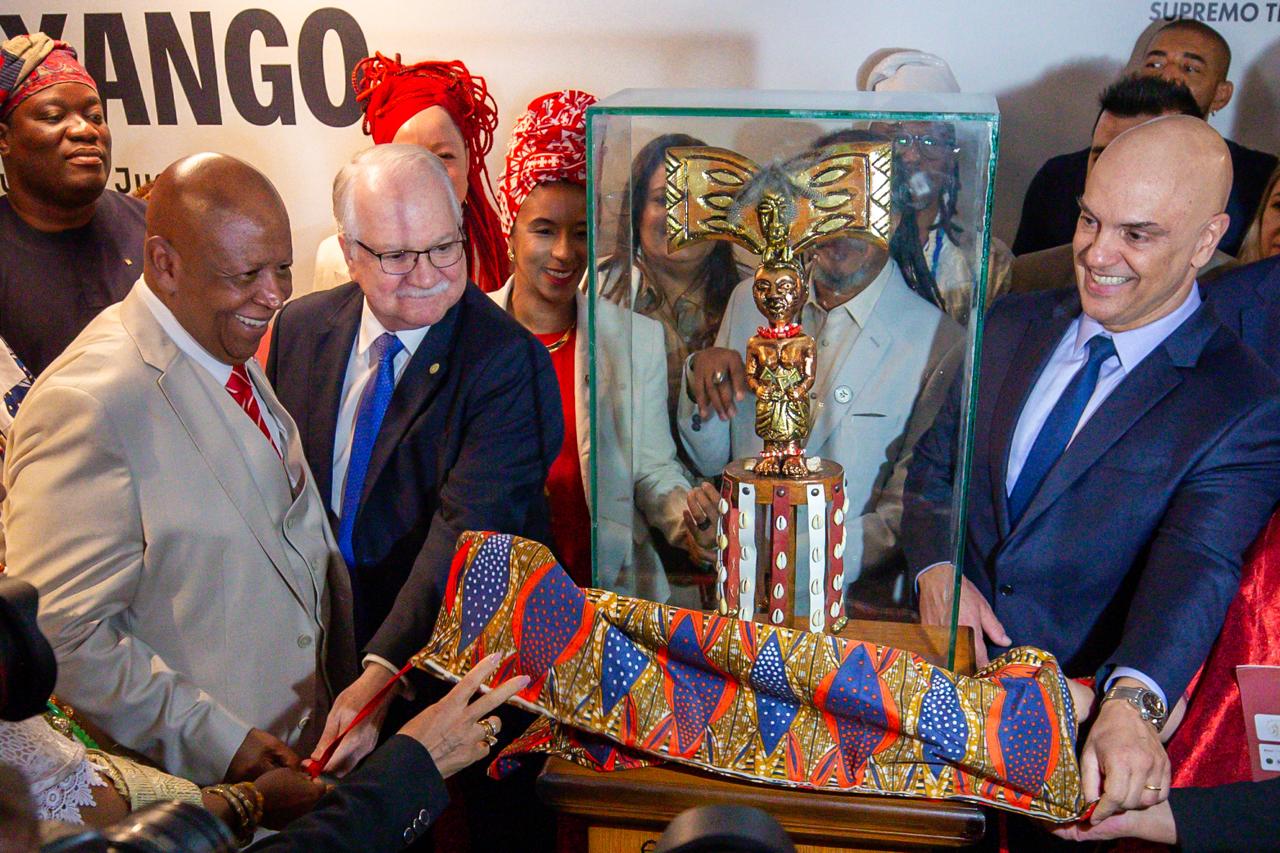
Brazil's Supreme Court installed a sculpture of the Oxê de Xangô, a double-bladed ax symbolizing justice in Yoruba tradition, in its ceremonial hall on Tuesday ahead of Black Consciousness Day on Nov. 20.
Hédio Silva Júnior, a lawyer and founder of the Institute for the Defense of the Rights of Afro-Brazilian Religions, requested the installation after Brazil's Supreme Court ruled in 2024 that religious symbols such as crucifixes can remain in public buildings when they reflect Brazilian cultural tradition. Silva Júnior brought together 12 religious leaders and submitted the request in February 2025.
"The Oxê de Xangô embodies a duality, with two sides that can represent formal equality and substantive equality," Silva Júnior said. He stated that fighting discrimination requires both punishing those who discriminate and adopting policies that promote equality.
Brazil observes Black Consciousness Day as a national holiday for the third time on Friday. The date commemorates Zumbi dos Palmares, a leader of Quilombo dos Palmares, a network of communities founded by people who escaped slavery in colonial Brazil. The Palmares Group in Porto Alegre chose Nov. 20 in 1971 to honor Zumbi, marking the anniversary of his death.
It took decades for Nov. 20 to gain national recognition. The Unified Black Movement adopted the date in 1978 during Brazil's military dictatorship. A 2011 federal law established National Zumbi and Black Consciousness Day, and in December 2023, President Luiz Inácio Lula da Silva signed a bill making Nov. 20 a national holiday. Brazil observed the holiday nationwide for the first time in 2024.
Amilcar Araujo Pereira, a historian and professor at the Federal University of Rio de Janeiro's School of Education, said the shift in commemoration from May 13, the anniversary of Princess Isabel's signing of the Golden Law in 1888, to Nov. 20 changed the focus from Isabel's signing to Black resistance and enslaved people's fight for freedom.