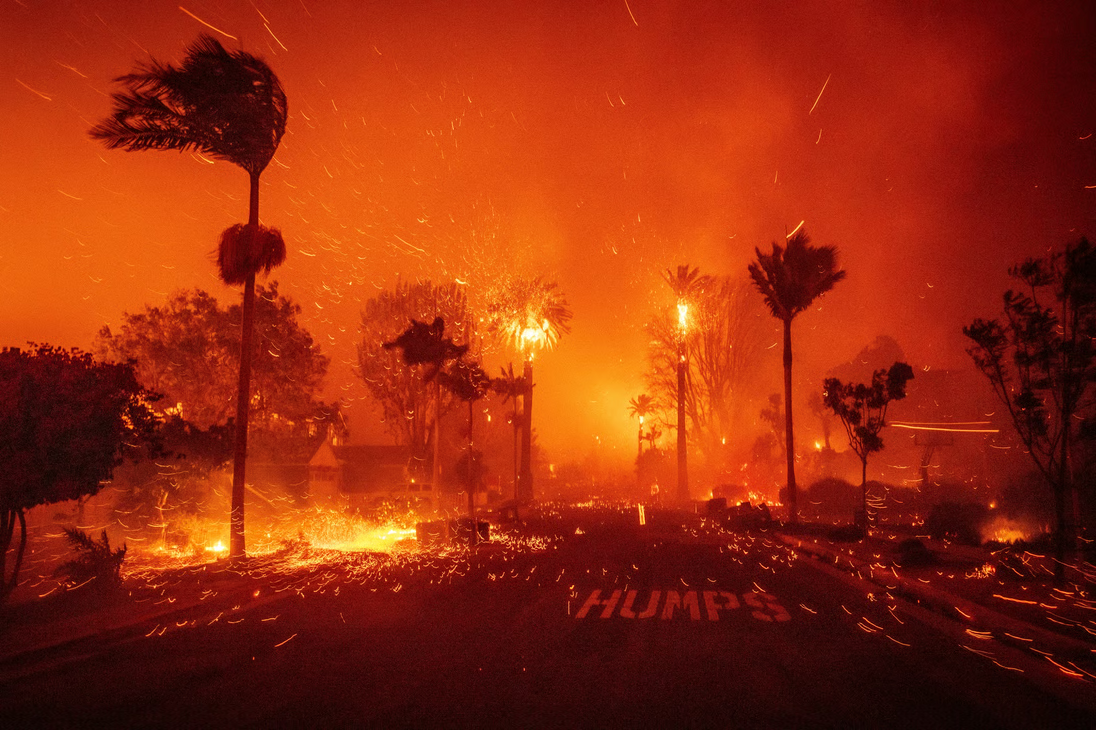
Jonathan Rinderknecht, 30, stood trial for a second time in federal court in Los Angeles on charges he started the brush fire that became the Palisades Fire, one of the most destructive fires in Los Angeles history.
Rinderknecht faces two counts of arson. He is accused of igniting the Lachman Fire shortly after midnight on Jan. 1, 2025, in the Pacific Palisades. That fire smoldered for six days before reigniting as the Palisades Fire on Jan. 7 when Santa Ana winds hit the region. The Palisades Fire destroyed thousands of homes and killed 12 people before containment on Jan. 31, 2025.
The first jury in June split 10-2 in favor of acquittal, prompting U.S. District Judge Anne Hwang to declare a mistrial.
Assistant U.S. Attorney Mark Williams told the second jury that Rinderknecht, an ex-Uber driver, parked his car near a trailhead and hiked to the Hidden Buddha clearing in the hills above Pacific Palisades homes. Surveillance footage from wildfire detection cameras recorded the first signs of fire near that clearing shortly after midnight, matching the location of Rinderknecht's cellphone data, Williams said. He alleged Rinderknecht used a large grill lighter, later found in his car's glove compartment, to ignite the shrubs.
Williams noted that Rinderknecht called 911 to report the fire and asked ChatGPT whether he could be held responsible for a fire started by a cigarette, suggesting he was establishing an alibi. Williams said Rinderknecht had been angry that night, citing angry texts to a girlfriend and rants to Uber passengers.
Assistant U.S. Attorney Danbee Kim argued in rebuttal that Rinderknecht's statements to investigators proved he lied about his location when the fire started. His cellphone data placed him at the clearing on the hill when calling 911, not at his car down the hill as he claimed, Kim said.
Rinderknecht's attorney, Steven Haney, argued there were too many gaps in the government's evidence to prove guilt beyond reasonable doubt. He contended that New Year's Eve fireworks could have started the fire, noting that neighbors reported hearing fireworks and the surveillance cameras captured only still images at one-minute intervals, which may have missed fireworks activity. He also pointed out that the fire scene was not preserved until more than 10 days after the incident.