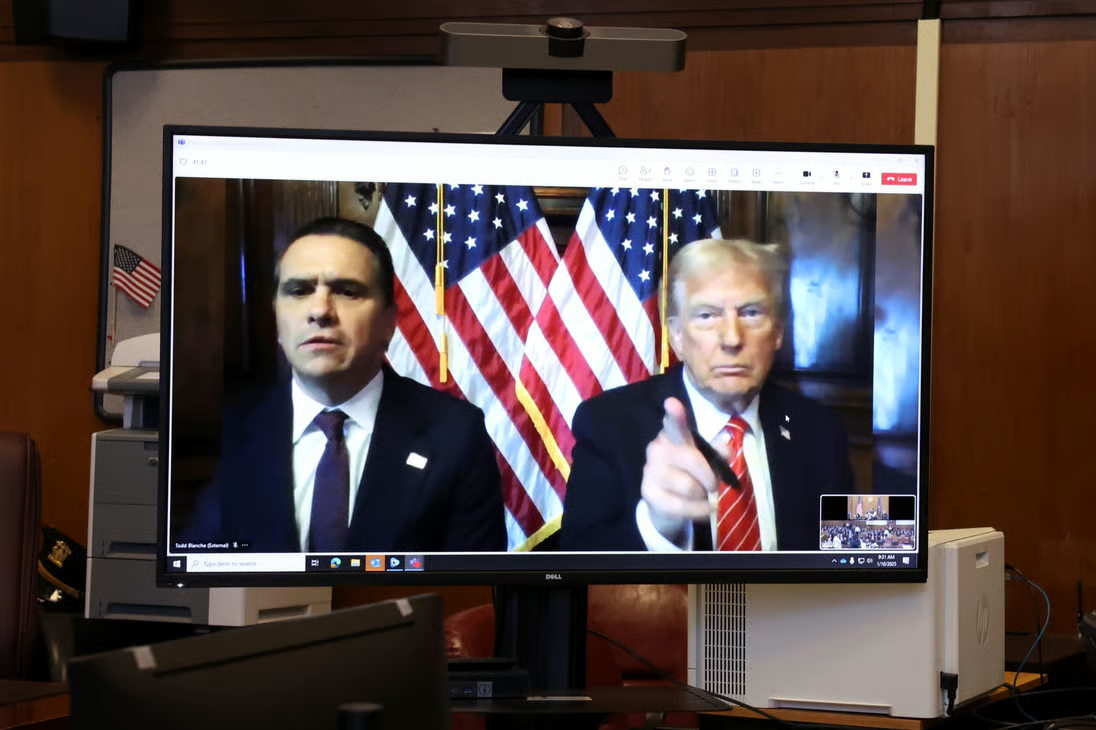
Trump argued before the Second Circuit on Monday that his New York state criminal convictions should be transferred to federal court, where he seeks to overturn the jury verdict based on presidential immunity.
The Manhattan District Attorney brought the state prosecution, which led to Trump's conviction in May 2024 on 34 counts of falsifying business records related to hush money payments to multiple women. Trump's defense teams have attempted to move the case from state court to federal court on the basis that he should have been shielded from prosecution for official acts.
Trump's defense attorney Robert Giuffra from Sullivan & Cromwell argued Trump was entitled to removal to federal court because it was timely filed within 60 days of the Supreme Court's July 2024 ruling in Trump v. United States, which gave former presidents absolute immunity for duties within their core powers and some immunity for other official actions.
"The appeal of this unprecedented criminal case brought by the state of New York against the president of the United States belongs in federal court," Giuffra said.
Giuffra argued the case involves federal preemption because the Manhattan District Attorney's office enhanced a time-barred misdemeanor and turned it into a felony by essentially charging Trump with violations of the Federal Election Campaign Act.
New York argued Trump failed to establish good cause to file a second notice of removal because he did not diligently pursue removal when he first raised his evidentiary claim based on presidential immunity in state court.
U.S. Circuit Judge John Walker pressed Trump's defense to cite any case in which a federal appellate court on removal had reviewed a state court decision. Giuffra pointed to the 2024 D.C. Circuit case Harris v. United States DOT.
U.S. District Judge Alvin Hellerstein, a Bill Clinton appointee in the Southern District of New York who died last month, previously rebuffed removal efforts.
U.S. Circuit Judges Raymond Lohier, a Barack Obama appointee, and Jose Cabranes, a Clinton appointee, joined Walker on the panel, which did not immediately rule.