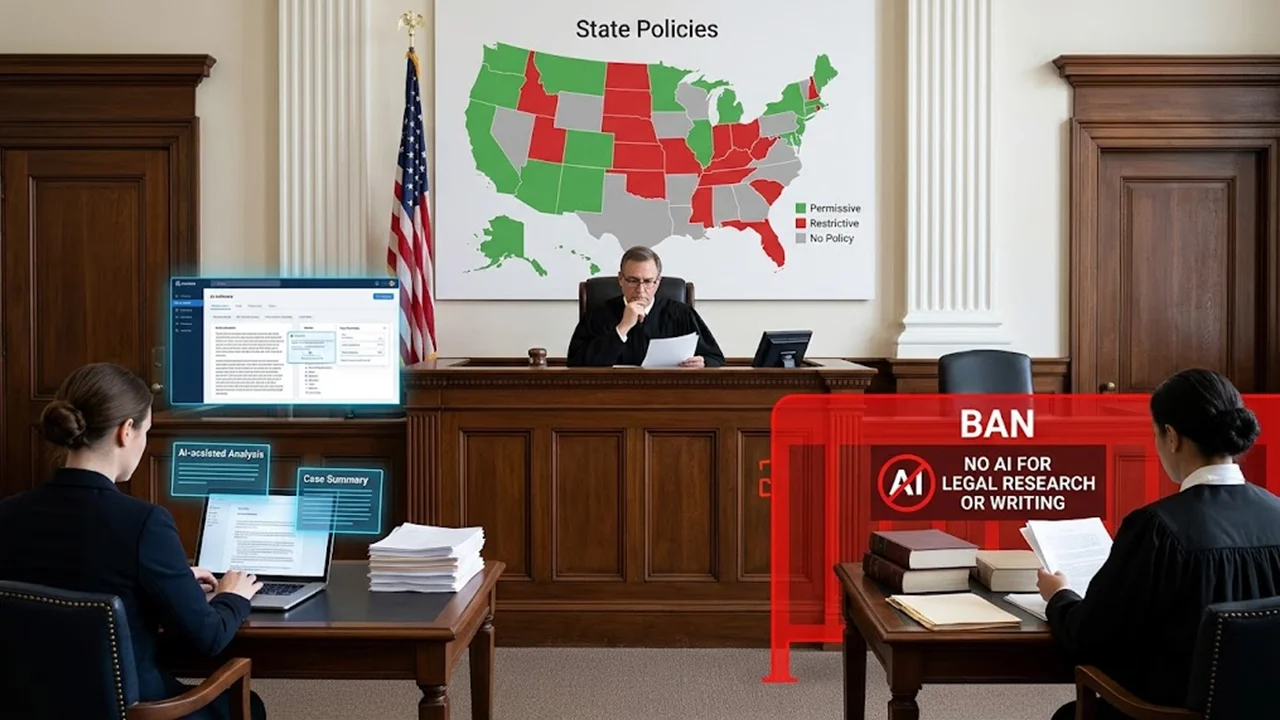
Clio, a legal technology company, is developing artificial intelligence tools for judges and courts through recent hires and acquisitions, but a 50-state survey shows judicial policies on AI use vary widely, from outright bans to permissive approaches to no policies at all.
Clio hired Pablo Arredondo, Casetext cofounder, as senior vice president for judiciary, and Bridget M. McCormack, former Michigan Supreme Court chief justice, as general manager for judiciary. The company also acquired Learned Hand, a startup that builds AI for judges and courts.
Massachusetts has adopted the most restrictive policy in the country. Its November 2025 "Interim Guidelines for use of Generative AI" prohibits judges, clerks, law clerks, interns, and court employees from using AI for legal research, legal writing, or other legal work. The guidelines permit AI only for administrative tasks. Massachusetts indicated the guidelines will be refined as more becomes known about generative AI, but no modifications have been made as of last week.
New York takes a more permissive approach. Its September 2026 ethics opinion expressly authorizes using private AI to summarize judicial proceeding transcripts and allows approved AI tools under specified conditions.
Rhode Island issued detailed judicial guidance on AI that is advisory rather than binding.
Across policies, one consistent principle emerges: judges cannot delegate their judgment to AI. Several states, including Arizona, New York, Pennsylvania, South Carolina, Utah, and Virginia, have adopted controls over which tools court personnel may use. Some require training, supervisory permission, or disclosure of AI use to the employing judge.
Iowa adopted comprehensive rules effective January 1, 2027, governing judges and adjudicative assistants while preserving independent judicial decision-making and requiring verification of legal and factual sources. Kansas established a committee to recommend internal judicial-branch policies. Kentucky identified limited administrative controls within its judicial information-technology operations.
No single national approach to judicial AI use exists, according to the survey. Policies range from detailed rules to broader ethical statements to no policy at all. Where policies permit AI-generated research, summaries, or drafting, judges retain responsibility for independently understanding the record, applying the law, and deciding the case.