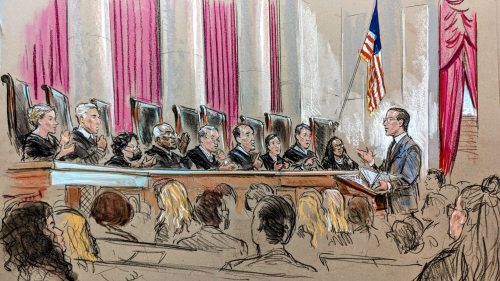
# Supreme Court's 2026-27 Term Opens with Sharp Ideological Divisions on Constitutional Reach
The Supreme Court heard its first oral arguments of the 2026-27 term, revealing persistent ideological fractures that will likely shape rulings across administrative law, regulatory authority, and fundamental constitutional questions. The early arguments previewed the Court's direction on whether federal agencies retain broad power to interpret statutes and whether that power requires explicit congressional authorization.
The conservative majority, anchored by Justices Samuel Alito, Clarence Thomas, and Neil Gorsuch, pressed counsel from the Biden administration and various regulatory agencies on the scope of Chevron deference. This doctrine, established in Chevron U.S.A. v. Natural Resources Defense Council, has governed judicial review of agency interpretations for four decades. The majority signaled skepticism toward permitting agencies to fill statutory gaps without clear congressional direction.
Justice Gorsuch questioned whether agencies possess power the Constitution does not explicitly grant them. His line of questioning targeted the major questions doctrine and whether agencies can resolve matters of vast economic and political consequence without explicit congressional authorization. Justice Alito emphasized that courts must determine whether Congress intended to delegate a particular power, not defer to agency judgment on that threshold question.
The Court's three liberal justices, Sotomayor, Kagan, and Jackson, warned of practical chaos if the Court curtails agency authority. Justice Kagan highlighted the impossibility of Congress anticipating every regulatory detail across hundreds of statutes governing complex industries like pharmaceuticals, environmental protection, and financial services. Justice Sotomayor stressed that many statutes delegate interpretive authority by design, reflecting realistic legislative compromise.
Justice Barrett posed methodical questions about limiting principles. She appeared concerned that wholesale elimination of Chevron deference would leave courts with insufficient guidance on how much deference agencies merit. Her skepticism toward both extreme positions suggested she might anchor a narrower holding that preserves some agency authority while tightening its boundaries.
Chief Justice Roberts pursued a middle path during questioning, suggesting the Court might narrow rather than abolish Chevron. He asked whether a reformed framework could require agencies to demonstrate explicit congressional intent for major policy shifts while retaining flexibility on technical matters.
The arguments touched three critical cases addressing tax authority, healthcare regulations, and environmental enforcement. Each case presents the Court with opportunities to recalibrate the balance between legislative deference and judicial constraint on executive power. The rulings will reshape how federal agencies operate and fundamentally alter the relationship between Congress, courts, and regulatory bureaucracies.
Lower courts already sense shifting winds. Federal judges anticipate that any Supreme Court decision reducing agency deference will embolden challengers to existing regulations and statutes. Businesses will likely file more suits challenging rules they previously deemed legally unreviewable. States opposing federal environmental and labor standards will accelerate litigation strategies.
Congressional response remains uncertain. If the Court restricts agency authority, Congress may feel compelled to write more detailed statutes or explicitly authorize agency gap-filling. Alternatively, legislative gridlock might leave agencies vulnerable to judicial second-guessing on complex matters.
The term's early arguments confirm the Court remains divided on foundational separation-of-powers questions. The composition and ideological alignment of the current bench suggest the Court will tighten constraints on administrative power, reshaping federal governance for years ahead.