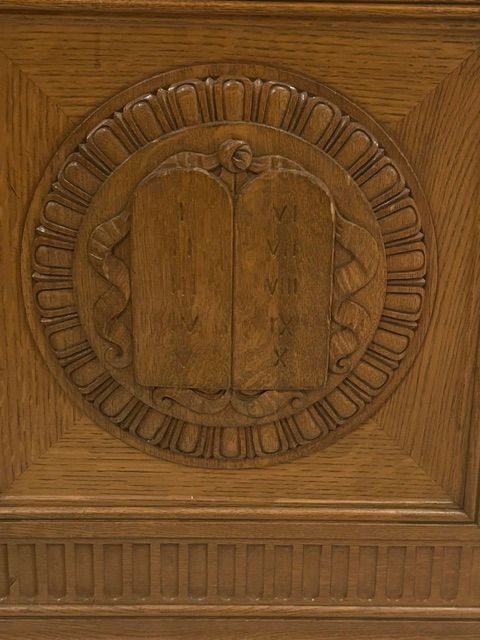
# The Ten Commandments, Classroom Walls, and the Establishment Clause
The Supreme Court faces a renewed clash over religious displays in public schools, a dispute rooted in First Amendment doctrine that has divided the justices for decades. The central question asks whether posting the Ten Commandments on classroom or school building walls violates the Establishment Clause, which prohibits Congress from establishing religion.
This conflict pits two competing constitutional interests against each other. Supporters of the displays argue the Ten Commandments represent historical and moral foundations of American law. Opponents contend that posting religious texts in publicly funded schools improperly endorses religion and compels students to encounter religious messaging in spaces they cannot avoid.
The Establishment Clause claim rests on the framework established in Lemon v. Kurtzman, 403 U.S. 602 (1971), which required courts to examine whether government action has a primary religious purpose, whether its principal effect advances or inhibits religion, and whether it creates excessive government entanglement with religion. However, the Supreme Court substantially revised this test in recent years. In Kennedy v. Bremerton School District, 142 S. Ct. 2407 (2022), the Court abandoned the Lemon framework entirely, replacing it with a historical and traditions-based analysis that asks whether practices align with longstanding American customs.
The Ten Commandments display controversy directly implicates this doctrinal shift. Under the old Lemon test, courts likely would have found that posting religious texts in classrooms fails the first prong because the primary purpose involves religious messaging. Under the new framework, courts must ask whether displaying Ten Commandments reflects historical practice in American public education.
Several lower courts now grapple with this question. Religious liberty organizations argue the commandments function as secular moral instruction, not religious promotion. Public school districts and civil rights groups counter that the commandments unambiguously communicate religious doctrine and fail to serve any genuine secular educational purpose when displayed on school walls without scholarly context.
The practical stakes affect millions of students and hundreds of school districts. If the Supreme Court permits such displays, districts face pressure to install them despite community objections. If courts prohibit them, religious communities argue their traditions face marginalization in public spaces.
At least one state legislature has acted preemptively. Louisiana passed a law requiring public school classrooms to display the Ten Commandments, though a federal judge blocked enforcement in 2024, finding the statute violated the Establishment Clause even under the revised constitutional standard. The judge concluded that Louisiana's stated secular purposes (teaching morality and historical foundations of law) did not represent the law's actual motivation, and that displaying religious texts in compulsory educational settings creates impermissible religious pressure on students.
This case likely heads toward Supreme Court review. The justices' recent religious liberty decisions suggest they may prove receptive to permitting displays, given their emphasis on historical practice and skepticism toward strict separationism. However, even a conservative majority might distinguish between acknowledging religious traditions in historical or museum contexts and mandating religious texts in active learning environments where attendance is compulsory.
The resolution will reshape how schools navigate religious expression, affecting display policies, curriculum choices, and community relations across the nation.