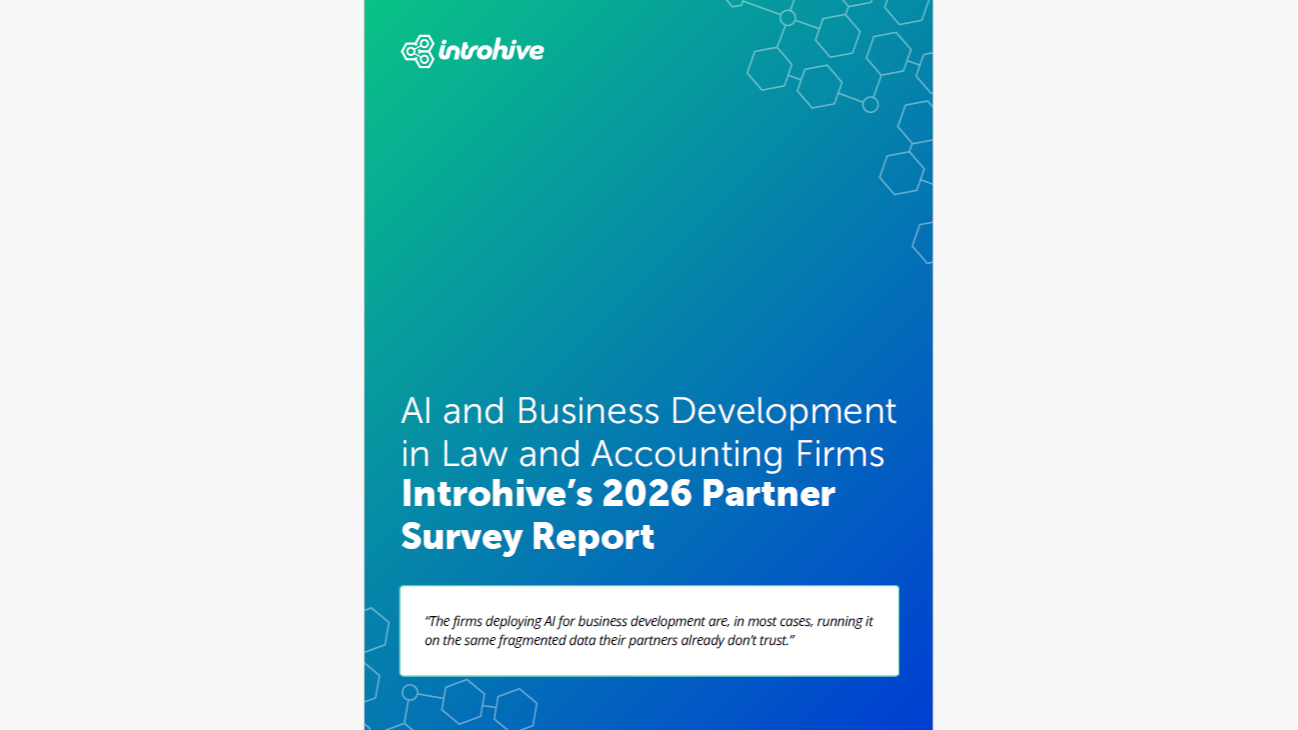
# Law Firm Partners Deploy AI on Unusable Data, Creating Business Development Risk
Law firm partners want artificial intelligence to identify new client opportunities, but most lack clean, usable data to train their AI systems effectively. That disconnect emerged from a survey by Introhive, a legal software company specializing in client relationship intelligence.
The findings reveal a critical gap between ambition and execution in legal technology adoption. Partners recognize AI as a tool for business development but operate the systems on data sets that cannot reliably power those tools. The result leaves firms investing in AI infrastructure while undermining the accuracy and utility of the technology itself.
Introhive CEO Lee Blakemore told LawSites the survey results triggered "mixed emotions." The optimism around AI adoption within law firms collides with the reality that data quality remains a pervasive problem. Most law firms have accumulated years of unstructured, inconsistent, and fragmented client information across disparate systems. Email, matter management platforms, CRM tools, and spreadsheets contain overlapping and contradictory records that no AI engine can parse reliably.
Partners expect AI to surface dormant client relationships, identify cross-selling opportunities, and flag matters within existing clients' businesses. These use cases require complete, accurate, and current data. When firms feed AI systems garbage, the output proves equally unreliable. An algorithm trained on incomplete or mislabeled client records will miss opportunities or generate false leads, undermining partner confidence in the technology.
The legal market has experienced a wave of AI adoption over the past two years. Law firms invested in predictive analytics platforms, contract review AI, and legal research tools. Business development AI represents the next frontier. Unlike contract analysis or document review, business development AI depends entirely on the quality of relationship data a firm maintains. No algorithm can manufacture connections that don't exist in the firm's records.
This creates a cascading problem for law firms pursuing growth. Firms that have not invested in data governance, client data hygiene, or a centralized CRM platform cannot deploy AI effectively. Partners at those firms may demand AI solutions, but the infrastructure necessary to support those tools remains absent. Introhive's survey likely indicates that most firms fall into this category.
The solution requires firms to address the unglamorous work of data standardization before deploying sophisticated AI. Partners must implement firm-wide standards for client naming, contact information, matter classification, and relationship history. This demands investment in time, resources, and often software tools designed specifically for data cleansing. Few firms prioritize this work because it produces no immediate revenue.
Firms competing for business development advantages now face a choice. They can invest upfront in data infrastructure and governance to prepare for AI deployment, or they can deploy AI on weak data and accept unreliable results. The first path requires patience and resources. The second path wastes money on technology that underperforms.
As AI tools proliferate in the legal market, firms that understand data quality will gain competitive advantage. Those that skip the foundational data work will discover that AI delivers disappointing results, reinforcing skepticism about the technology itself. The Introhive survey captures this moment where legal technology has advanced faster than legal operations infrastructure. Closing that gap determines whether AI serves as a genuine business development accelerant or becomes another underutilized software subscription.