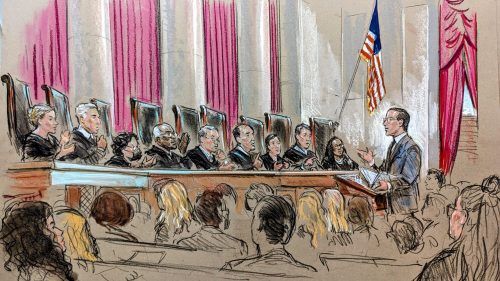
# Supreme Court's Internal Dynamics Reshape Traditional Power Alignments
The Supreme Court's decision-making process extends far beyond identifying a single swing justice, according to recent analysis of voting patterns and opinion assignment. Researchers examining the Court's institutional mechanics have identified multiple justices who function as "majority makers" rather than mere swing votes, fundamentally altering how coalitions form and dissolve across terms.
Traditional swing justice analysis focuses on individual justices who vote unpredictably across ideological lines. However, scholars now recognize that justices who serve as "dissent bridges" hold distinct institutional power. These justices maintain credibility within both ideological camps, allowing them to shape consensus positions and negotiate outcomes that satisfy multiple constituencies within the nine-member bench.
The research documents "coalition drift" as a persistent feature of the modern Court. Cases that appear ideologically aligned often splinter based on doctrine, statutory interpretation nuances, and procedural posture rather than pure ideological preference. A justice aligned with the conservative bloc on constitutional questions may shift positions when the case hinges on administrative law or statutory construction.
Opinion assignment patterns reveal intentional strategy. Chief Justices and senior justices leverage their power to designate opinion writers, using assignments to consolidate coalitions or prevent defection. A justice tasked with writing the majority opinion gains leverage to demand concessions from wavering colleagues, effectively making that justice a majority maker regardless of initial vote alignment.
The analysis carries profound implications for predicting Court outcomes. Cases cannot be evaluated purely through ideological mapping. Instead, examining individual justices' historical positions on specific doctrine categories, their relationships with colleagues, and the procedural posture of particular disputes offers more accurate forecasting than crude left-right classifications.
This institutional view explains seemingly contradictory decisions within single terms. The same justice may anchor the liberal wing on one case while joining conservative colleagues on another, reflecting doctrine-specific rather than