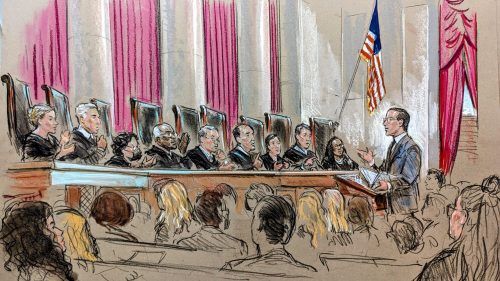
# Supreme Court Ideological Analysis Raises Methodological Questions
Legal scholars debate whether measuring "ideology" among Supreme Court justices produces meaningful insights about judicial behavior. The question reflects ongoing tension between interpreting the Constitution as written versus accommodating contemporary values and policy preferences.
Researchers have attempted to quantify ideological positioning using voting patterns, opinion authorship, and case outcomes. Justice Clarence Thomas frequently appears at one end of these analyses, having authored originalist opinions rejecting precedents spanning decades. Justice Elena Kagan occupies the opposite pole in many studies, with voting patterns aligned to progressive outcomes. The methodological challenge lies in distinguishing genuine constitutional interpretation from personal preference.
Critics argue ideology metrics collapse distinct judicial philosophies into single-axis measurements. An originalist judge interpreting the Second Amendment broadly and the Commerce Clause narrowly reflects constitutional methodology, not inconsistent ideology. Similarly, a living constitutionalist might reach outcomes that appear ideologically coherent only when filtered through particular policy lenses.
The Federalist Society and progressive legal networks have developed competing frameworks for constitutional interpretation. Both attract adherents whose votes correlate predictably. This raises the core question: does correlation between judicial philosophy and voting outcomes demonstrate ideology, or does it simply show that judges apply consistent interpretive methods?
Empirical research by scholars including Lee Epstein and Andrew Martin demonstrates that Supreme Court voting patterns show ideological clustering. Yet their own data acknowledges that individual cases involve complex statutory language, procedural rules, and precedential constraints that constrain purely ideological voting.
The practical implications extend beyond academic debate. Confirmation hearings increasingly focus on ideology prediction. If the question "is ideology measurable" lacks clear answers, the Senate's ability to evaluate judicial impartiality remains uncertain. Likewise, predictions about how justices will vote on specific issues become speculative when ideology itself resists precise definition.
The debate ultimately reflects disagreement