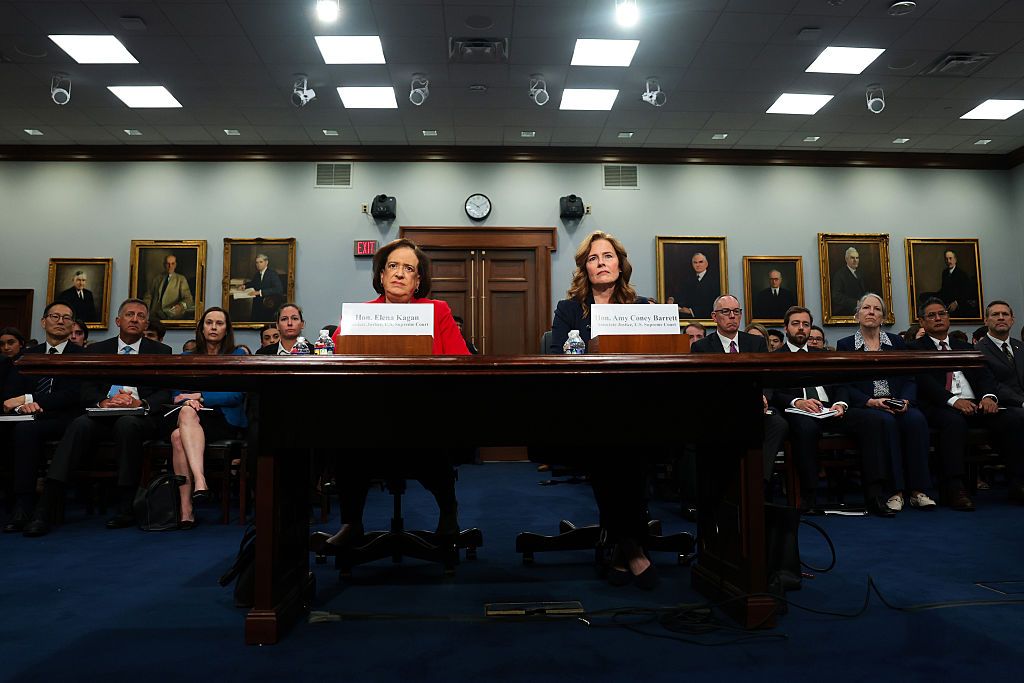
# Supreme Court Justices Defend Institution During Congressional Testimony
Supreme Court Justices Elena Kagan and Amy Coney Barrett testified before Congress, addressing institutional concerns and public criticism facing the nation's highest court. The justices defended the judiciary's independence and discussed the court's role in American governance.
Justice Kagan emphasized the court's commitment to the rule of law and impartial decision-making. She addressed concerns about judicial impartiality and the politicization of the bench, arguing that justices remain committed to interpreting the Constitution faithfully regardless of personal beliefs.
Justice Barrett discussed the nomination and confirmation process, fielding questions about her judicial philosophy and approach to constitutional interpretation. She emphasized that justices decide cases based on law, not politics, and stressed the importance of separating judicial reasoning from partisan concerns.
The testimony occurred amid heightened scrutiny of the Supreme Court following high-profile decisions and public debates over the court's composition and ideological direction. Congressional members questioned both justices about specific decisions, ethics concerns, and proposals for institutional reform, including term limits and court expansion.
Both justices reaffirmed the court's institutional legitimacy and warned against viewing the judiciary through a partisan lens. They emphasized that public trust in the courts depends on the perception that justices render decisions impartially.
The testimony reflects ongoing tension between Congress and the judicial branch over the court's proper role and composition. While justices traditionally avoid extensive political engagement, recent institutional pressures have prompted greater visibility and direct communication with lawmakers. The appearance represents a notable moment in the fraught relationship between the legislative and judicial branches, with fundamental questions about institutional independence and public confidence in the courts at stake.