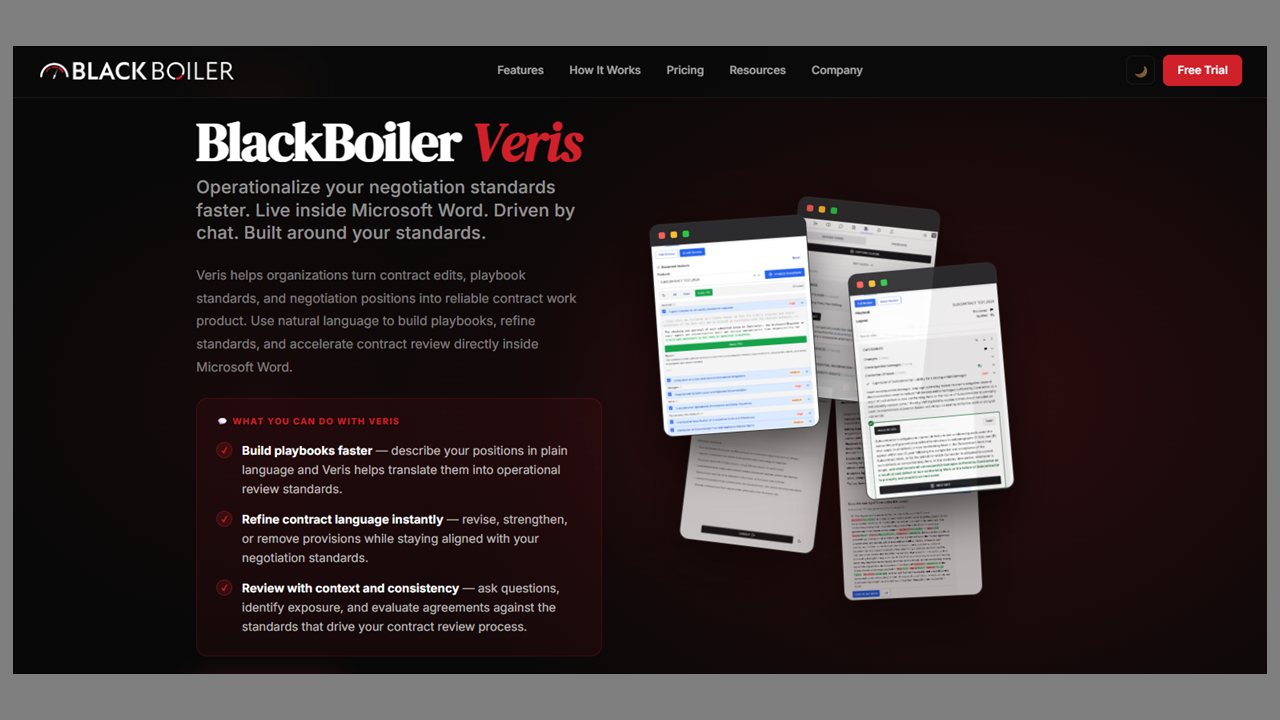
BlackBoiler, a legal technology firm specializing in contract analysis, launched Veris, a Microsoft Word add-in that integrates deterministic redlining with generative artificial intelligence for contract review and negotiation. The tool operates directly within Word documents, enabling contract-review teams to identify issues, suggest revisions, and mark up agreements without switching between applications.
Veris combines two distinct technological approaches. Deterministic redlining uses rule-based algorithms to flag contract language based on predetermined criteria and established legal standards. This method delivers consistent, predictable results grounded in established contract principles. The generative AI component supplements this foundation by offering contextual suggestions and alternative language options that adapt to specific negotiation scenarios and client preferences.
The integration into Microsoft Word addresses a workflow bottleneck facing legal departments and contract teams. Rather than exporting documents to specialized contract-review platforms, uploading files, and switching back to Word to implement changes, users now perform all review and markup functions within their existing document editor. This embedded approach reduces friction in contract negotiations and accelerates turnaround times.
The practical application extends to negotiation teams at law firms, corporate legal departments, and business entities handling multiple contract reviews simultaneously. Teams can track revisions, collaborate on suggested changes, and maintain version control without fragmenting work across multiple software platforms. The deterministic foundation ensures baseline consistency across contracts, while the generative layer allows customization for client-specific requirements and risk tolerances.
BlackBoiler's product positioning reflects broader industry trends in legal tech toward AI-assisted document analysis combined with embedded workflow tools. By operating inside Word, Veris reduces training requirements and adoption friction compared to standalone platforms requiring users to develop new habits and processes.
The launch carries implications for contract administration efficiency and risk management. Organizations gain access to both systematic legal analysis and adaptive AI-driven suggestions within familiar software. This dual approach potentially reduces negotiation cycles while maintaining compliance with