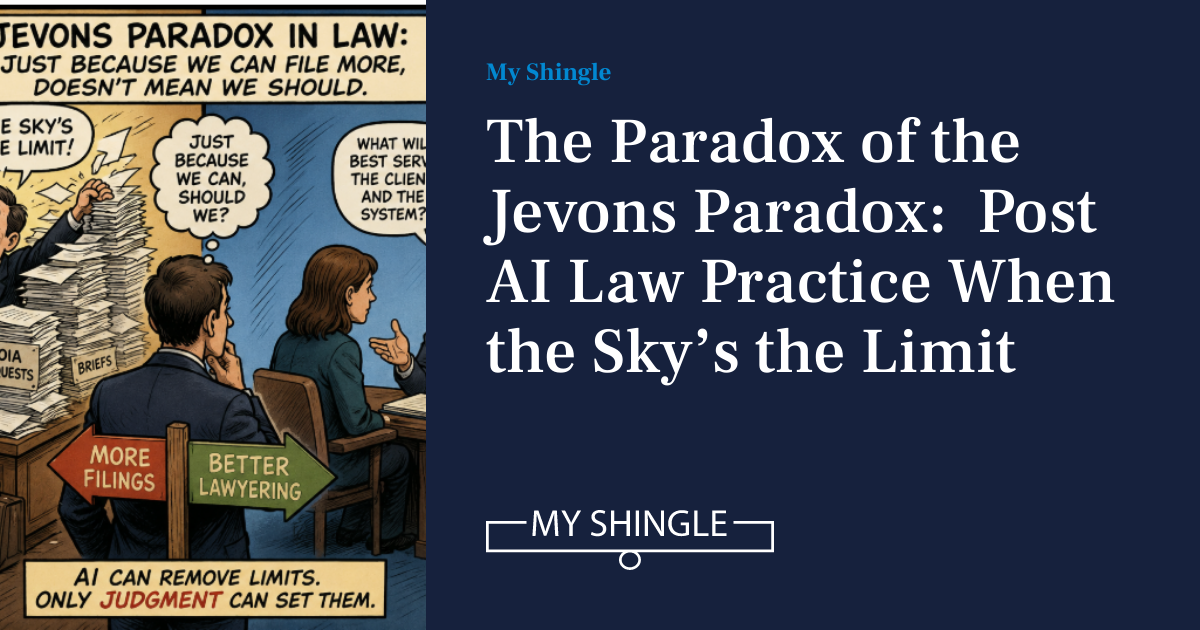
# The Paradox of the Jevons Paradox: Post AI Law Practice When the Sky's the Limit
Artificial intelligence will reshape legal practice economics, but the profession faces an ethical question that transcends efficiency gains. As AI tools reduce the cost of producing legal work, lawyers must confront a troubling paradox: lower production costs historically trigger increased consumption, not improved quality or access.
The Jevons Paradox describes this phenomenon. In 1865, economist William Stanley Jevons observed that coal consumption rose after steam engines became more efficient, not because engines needed more fuel, but because cheap energy spurred new demand across industries. The same dynamic threatens legal practice. When AI reduces billable hours and document review costs to near zero, law firms will face pressure to generate more legal output, not to charge less or serve more clients pro bono.
This creates a fundamental tension. Partners may rationalize increased work volume as meeting client demand or maximizing efficiency. Yet the ethical question remains: if AI enables lawyers to produce more legal memoranda, contracts, and filings with minimal human effort, should they? The answer depends on whether that work serves genuine client interests or simply generates revenue from unnecessary legal services.
Bar associations and law firms must establish guardrails before AI deployment accelerates this dynamic. Ethical rules against frivolous claims and unnecessary litigation exist, but they lack teeth in practice. When AI makes volume economically attractive, enforcement becomes critical.
The profession also risks stratification. Well-capitalized firms will deploy AI aggressively, reducing costs for corporate clients while increasing output volume. Solo practitioners and small firms without AI infrastructure face margin compression. Legal aid providers gain tools to expand access, yet budget constraints prevent meaningful scaling.
The real post-AI legal market will not resemble the efficient, accessible profession technology advocates promise. Instead, it will reflect the Jevons Paradox: