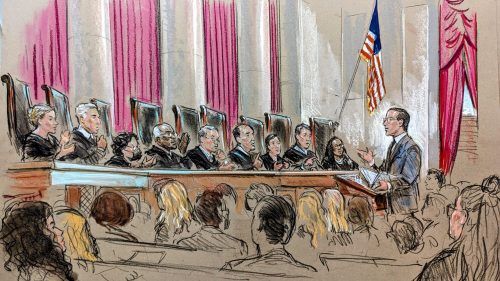
# The Roberts Court's Evolution and Legacy
Chief Justice John Roberts has presided over the Supreme Court for nearly two decades, shaping American constitutional law through his distinctive judicial philosophy. The Roberts Court, spanning from 2005 to the present, divides naturally into distinct periods marked by changing membership and ideological shifts.
During the early Roberts years, the Court maintained moderate conservatism. Roberts himself emerged as an institutionalist concerned with preserving the Court's public legitimacy. This era produced mixed results for conservative interests. The 2012 decision upholding the Affordable Care Act's individual mandate in National Federation of Independent Business v. Sebelius exemplified Roberts' pragmatic approach, prioritizing institutional credibility over ideological victory.
The second Roberts Court began solidifying after Justice Amy Coney Barrett replaced Ruth Bader Ginsburg in 2020, creating a durable 6-3 conservative supermajority. This reconstituted bench released decisions with sweeping conservative implications. The 2022 abortion decision overturning Roe v. Wade in Dobbs v. Jackson Women's Health Organization transferred abortion regulation entirely to states. That same term, the Court restricted the Environmental Protection Agency's authority in West Virginia v. EPA, limited voting rights protections, and expanded Second Amendment rights in New York State Rifle and Pistol Association v. Bruen.
Roberts' role shifted in this second iteration. Once the Court's decisive centrist, he found himself sidelined by colleagues further right. His frequent separate opinions reflected frustration with the majority's absolutism. On voting rights and affirmative action, Roberts opposed positions his colleagues adopted.
The two Roberts Courts represent fundamentally different institutions. The first operated with narrow margins requiring compromise and institutional concern. The second enjoys a supermajority capable of revolutionary change unconcerned with traditional restraint.
This division carries