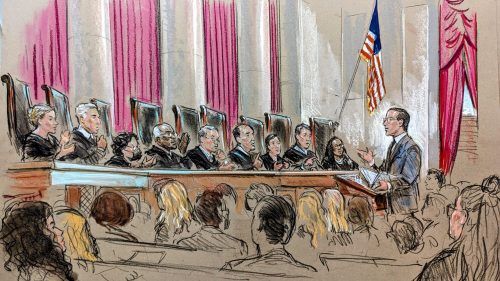
# The Two Roberts Courts
Chief Justice John Roberts has presided over the Supreme Court through two distinct judicial eras, each marked by fundamentally different ideological compositions and decisional patterns.
The first Roberts Court, spanning 2005 to 2020, operated with a shifting ideological center. Justice Anthony Kennedy held swing-vote authority during this period, forcing the conservative wing to moderate positions on major constitutional questions. The Court upheld the Affordable Care Act in 2012, recognized same-sex marriage rights in 2015, and declined to overturn abortion precedent in 2014. Roberts himself emerged as an institutionalist, prioritizing the Court's reputation and legitimacy over partisan outcomes. His decisive vote to uphold the ACA exemplified this approach, choosing institutional credibility over ideological consistency.
The second Roberts Court commenced in 2020 with Justice Ruth Bader Ginsburg's death and Amy Coney Barrett's appointment. The Court shifted decisively rightward. Kennedy's replacement by Brett Kavanaugh in 2018 eliminated the pivotal moderate voice. Barrett's arrival created a 6-3 conservative supermajority, granting conservative justices the votes to pursue their substantive agenda without needing Roberts's accommodation.
This transformed the Court's output. The second Roberts Court overturned Roe v. Wade in 2022, expanded gun rights, restricted voting rights protections, and limited the EPA's regulatory authority. Roberts remained institutionally cautious, occasionally joining liberals on narrow grounds rather than endorsing the majority's broadest reasoning. Yet he no longer determines outcomes. The new conservative majority governs independently of his mediation.
For litigants and lower courts, the distinction carries profound implications. The first Roberts Court offered unpredictability and opportunities for narrow victories. The second Roberts Court presents predictable conservative outcomes on constitutional questions affecting abortion, gun regulations,