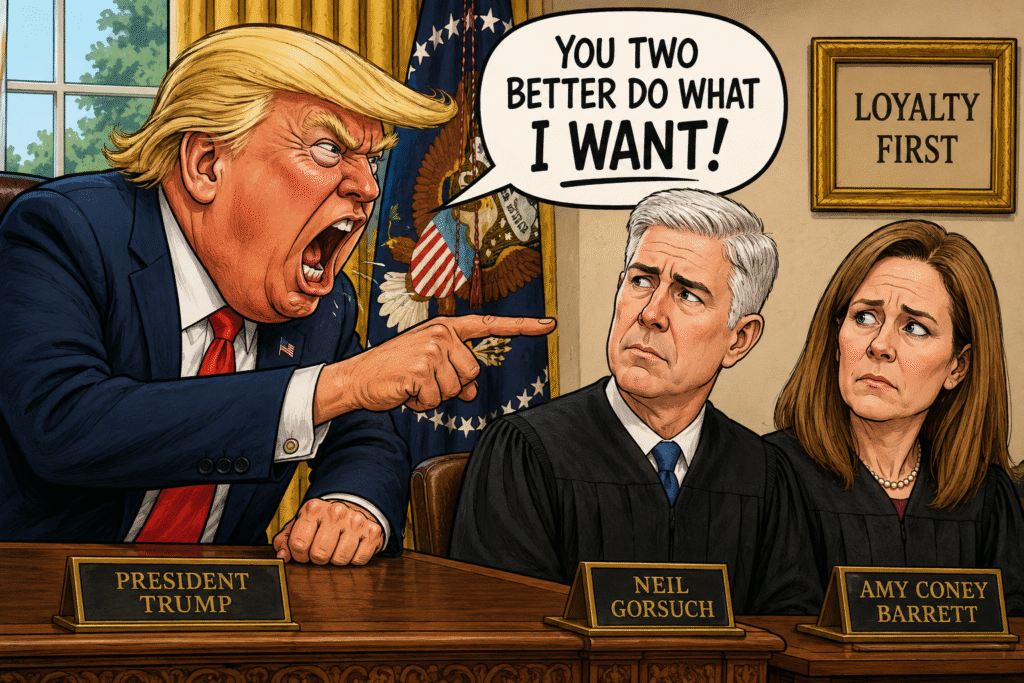
Former President Donald Trump posted on Truth Social demanding loyalty from Supreme Court Justices Neil Gorsuch and Amy Coney Barrett, asserting he appointed them and could remove them. The post reflects Trump's view that justices owe him political allegiance rather than independent judicial judgment.
Trump's language targets Gorsuch and Barrett specifically for decisions he opposed. Both justices, whom Trump appointed during his first term, have ruled against administration positions on key cases. Gorsuch voted to extend civil rights protections to LGBTQ employees in Bostock v. Clayton County. Barrett participated in decisions the Trump camp deemed unfavorable to his interests.
The post signals a fundamental misunderstanding of Article III judicial independence. Supreme Court justices hold lifetime tenure and cannot be removed by a president except through impeachment and conviction for high crimes and misdemeanors. Once confirmed and seated, justices answer to the Constitution and law, not the appointing president.
Trump's demand for loyalty from the judiciary threatens separation of powers. The president appoints federal judges with Senate confirmation, but those judges must maintain independence from executive pressure. Justices operate within a co-equal branch designed to check executive overreach.
The statement carries practical implications. It documents Trump's expectation that judicial appointments function as political favors requiring ongoing loyalty. This view contradicts decades of judicial ethics standards and constitutional design. Courts exist to apply law neutrally, not serve individual politicians.
The post also reflects how Trump may approach judicial appointments if returned to office. It suggests he views the judiciary as an extension of executive power rather than an independent branch. This threatens the institutional stability that depends on judges ruling according to law regardless of political consequences.
Gorsuch and Barrett have not publicly responded. Their silence underscores the awkward position Trump's public demands place judges in. They must ignore such pressure while maintaining professional relationships with a former president who may